Free tool
Repair or Replace? HVAC Decision Calculator
One of the hardest calls a homeowner faces is whether to keep repairing an aging furnace or air conditioner — or invest in a replacement. This free tool applies the industry rules of thumb (system age, repair cost, and typical lifespan) to give you a clear, unbiased starting point in about 30 seconds.
- 100% Free for Homeowners
- Independent & Unbiased
- Free Planning Tools & Cost Guides
- Built for Minnesota Homes
This is an educational estimate based on common industry rules of thumb, not a quote or professional diagnosis. Your best next step is a written assessment from a licensed contractor.
Overview
The hardest call an HVAC owner faces isn't which brand to buy — it's whether to keep fixing an aging system or invest in a new one. Repair another year, and you might pour money into equipment that fails next winter anyway. Replace too early, and you spend thousands you didn't need to. This calculator turns that gut decision into a data-based starting point using the same factors a trustworthy technician weighs: your system's age, the cost of the repair in front of you, and how that compares to a replacement.
It won't make the decision for you, and it isn't a substitute for a technician's eyes on your equipment. What it does is cut through the pressure of the moment — often a cold night with a dead furnace — so you can see, calmly and objectively, which way the numbers lean.
What this calculator does
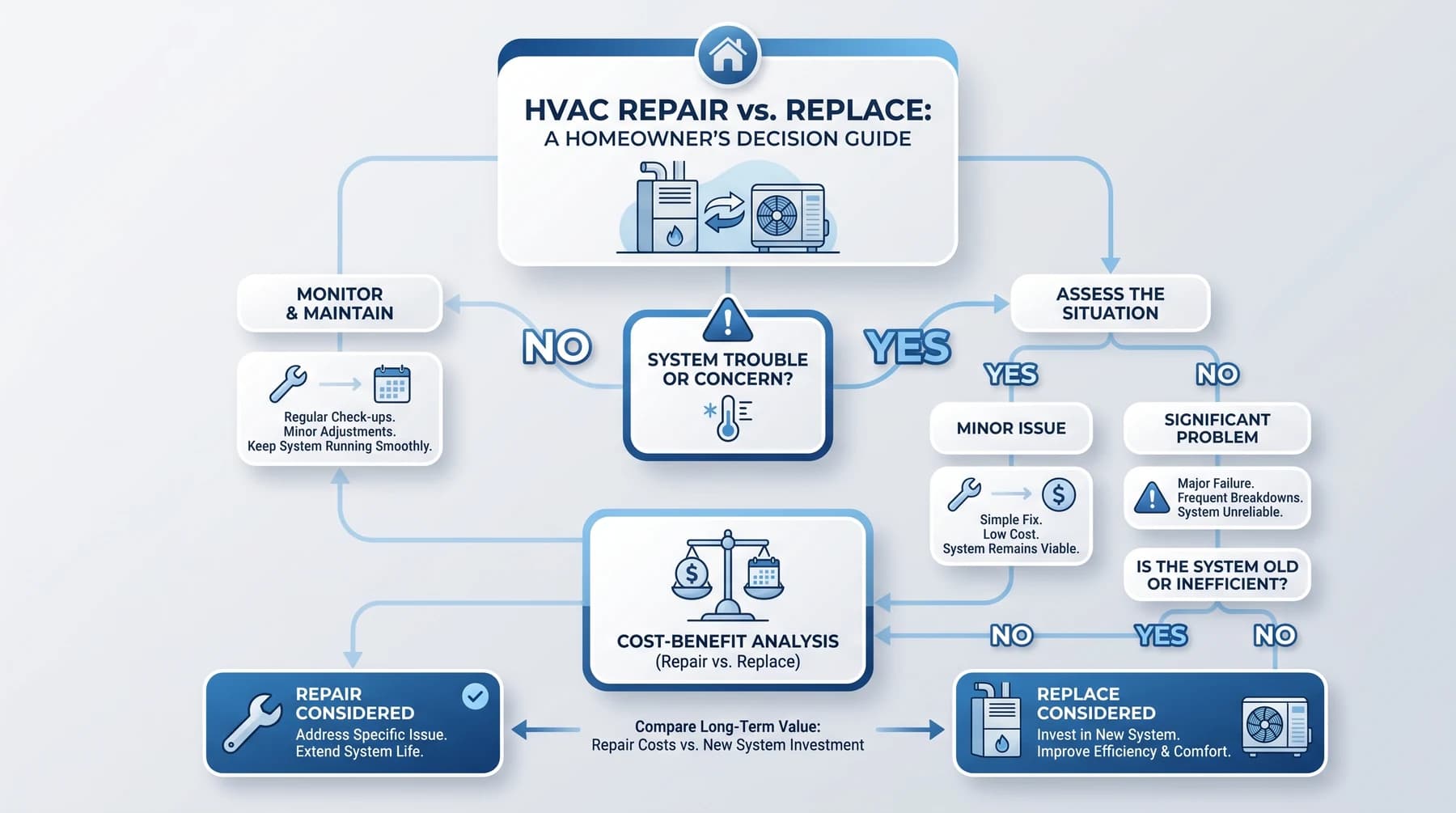
You enter the system type, its age, and the price of the repair you're considering. The tool weighs that repair cost against the system's remaining useful life and the cost of replacement, then gives you a clear lean: repair, replace, or a genuine toss-up that comes down to your budget and risk tolerance.
It's designed for the two moments this question arises: an unexpected breakdown with a repair bill on the table, and proactive planning when a system is simply getting old and you're deciding whether to get ahead of it.
When to use it
Use it the moment a technician hands you a repair quote on an older system, before you say yes. It's also useful during calm planning — if your furnace or AC is approaching the end of its typical lifespan, running the numbers now helps you replace on your terms instead of during an emergency in January.
If the system is newer and the repair is minor, the answer is almost always "repair," and the tool will say so. It earns its keep on the genuinely close calls.
How the calculation works
The logic combines two well-known industry rules of thumb. The first is the age test: every system has a typical lifespan (roughly 15–20 years for a gas furnace, 12–15 for central AC and heat pumps), and the closer you are to it, the weaker the case for a big repair. The second is the cost test: when a repair costs more than about a third to a half of a new system, replacement usually becomes the better long-term value.
A widely used shorthand is the "$5,000 rule" — multiply the equipment's age by the repair cost, and if the result exceeds $5,000, lean toward replacement. The tool blends these signals rather than relying on any single one, because a $400 repair on a 20-year-old furnace and a $1,800 repair on an 8-year-old one are very different decisions.
Methodology
The lifespan thresholds are industry-standard ranges, the same ones used in the System Lifespan estimator. The cost thresholds (the one-third rule, the 50% rule, and the age-times-cost heuristic) are long-standing contractor rules of thumb, not proprietary formulas — we use them because they're transparent and you can check the math yourself.
Crucially, the tool leaves the numbers you can verify — the repair quote, the system's age — in your hands, and only applies the comparison. It never invents a replacement price; for that, it points you to the cost estimator so both sides of the comparison come from figures you can see.
Assumptions it makes
- The repair quote you enter is accurate and covers the full fix, not a temporary patch.
- The system has been reasonably maintained; a neglected system reaches end-of-life sooner.
- Typical Minnesota usage — a long, hard heating season for furnaces and heat pumps.
- Replacement cost is estimated separately, using the cost estimator, so both sides are comparable.
- Safety issues (a cracked heat exchanger, for example) override the math — those mean replace, regardless of cost.
Limitations
- It can't assess condition. A well-kept 16-year-old furnace may outlast a neglected 12-year-old one; only a technician can judge wear.
- It doesn't factor in efficiency gains — a new system can cut energy bills enough to change the math in favor of replacing.
- It doesn't know about safety defects, which are automatic replace signals a calculator can't detect.
- It assumes one repair; a system needing its second or third repair in a year tilts strongly toward replacement even if each repair is small.
Worked examples
$900 control board on an 18-year-old furnace
Age × cost = 18 × 900 = $16,200, far past the $5,000 threshold, and the furnace is at the end of its expected life. The tool leans firmly toward replacement. The homeowner prices a new system with the cost estimator, checks rebates, and plans a replacement rather than sinking $900 into equipment that may fail again.
$250 capacitor on a 7-year-old AC
Age × cost = 7 × 250 = $1,750, well under the threshold, and the unit is barely half its expected life. The tool says repair — clearly. Spending thousands to replace a system with years left would be the expensive mistake here.
Common mistakes to avoid
- Letting a high-pressure sales pitch during a breakdown push a replacement that the numbers don't support.
- Repairing an old system twice in one season instead of stepping back and comparing total cost to replacement.
- Ignoring a cracked heat exchanger or other safety defect because the repair-vs-replace math "says repair" — safety wins.
- Comparing the repair to a bargain-basement replacement quote; use a realistic installed range instead.
- Forgetting that a new system's lower energy bills and available rebates change the true cost of replacing.
When to repair vs. replace
The short version: repair when the system is under about 75% of its typical lifespan and the fix is modest; replace when it's past its lifespan, the repair is large, safety is in question, or you're facing repeated breakdowns. When it's a genuine toss-up, let three things break the tie — energy savings from a new high-efficiency system, available Minnesota rebates, and how long you plan to stay in the home. If you're staying put and the incentives are strong, replacing early often pays for itself faster than people expect.
FAQ
Repair or Replace Calculator — questions homeowners ask
What is the $5,000 rule?
Multiply the equipment's age in years by the repair cost. If the result is over $5,000, lean toward replacement. It's a quick sanity check, not a hard law — the calculator blends it with lifespan and other signals.
At what age should I stop repairing my furnace?
There's no hard cutoff, but once a gas furnace passes about 15 years, big-ticket repairs rarely pay off, and past 20 years replacement is usually the smarter money. Central AC and heat pumps hit that point a few years sooner.
Does a safety problem change the answer?
Yes, completely. A cracked heat exchanger, a refrigerant leak in a failing compressor, or an electrical hazard means replace — regardless of what the cost math says.
Should I replace my furnace and AC at the same time?
If both are near end-of-life, replacing together saves on labor and lets you match the systems for efficiency. If only one is failing and the other is young, replace just the one that needs it.
How do I know my system's real remaining life?
Use the System Lifespan estimator for a data-based estimate from age and maintenance history, and have a technician confirm condition before a major repair.
Your next steps
Leaning toward replacement? Price it with the cost estimator, then lower that number with current rebates and tax credits and see the monthly payment with the financing calculator. Leaning toward repair? Make sure the quote is fair — the furnace repair cost and AC repair cost guides show what common fixes should run. Either way, get the work in writing and ask the right questions.
Related guides
Related calculators
Planning an upgrade? Check Minnesota rebates & tax credits before you buy.
Free download
Get the free Minnesota HVAC Buyer's Kit
The quote-comparison checklist, the exact questions to ask a contractor, fair Twin Cities price ranges, and the Minnesota rebate cheat sheet — emailed to you, free.
More tools
Keep exploring
Paste in what your contractor's quote includes and get a completeness score plus the exact questions to ask before you sign.
Open the toolSee a real Twin Cities price range for a new furnace, AC, or heat pump before you talk to anyone.
Open the toolSee how many years of life your furnace, AC, or heat pump likely has left.
Open the toolEstimate the monthly payment on a new furnace, AC, or heat pump — and see how term and rate change it.
Open the toolAnswer a few questions and get a clear, Minnesota-specific lean between a heat pump, a furnace, or a dual-fuel system.
Open the toolTell us your utility and what you're installing, and see the Xcel, CenterPoint, and federal rebate programs you likely qualify for.
Open the toolBy city
Using this tool for a specific city?
Pair your numbers with the local buying guide for your city — costs, common problems, permits, rebates, and how to hire.
Ready to see real numbers?
A calculator is a great start — a written quote from a local pro is the real answer. Compare free quotes with no obligation.